
There’s something deeply satisfying about a wall full of plates. Not in an old-fashioned, dusty-china-cabinet way — but in the way a well-curated gallery stops you mid-step and makes you look closer. Plates bring texture, color, and personality to walls that framed prints simply can’t replicate. And the best part? You can start with pieces you already own.
Whether you’re decorating a kitchen, a dining room, a bedroom, or a hallway, these 21 ideas cover every style, every room, and every budget — with real guidance on layout, spacing, and execution so your display looks intentional, not accidental.
1. 🔲 The Symmetrical Grid
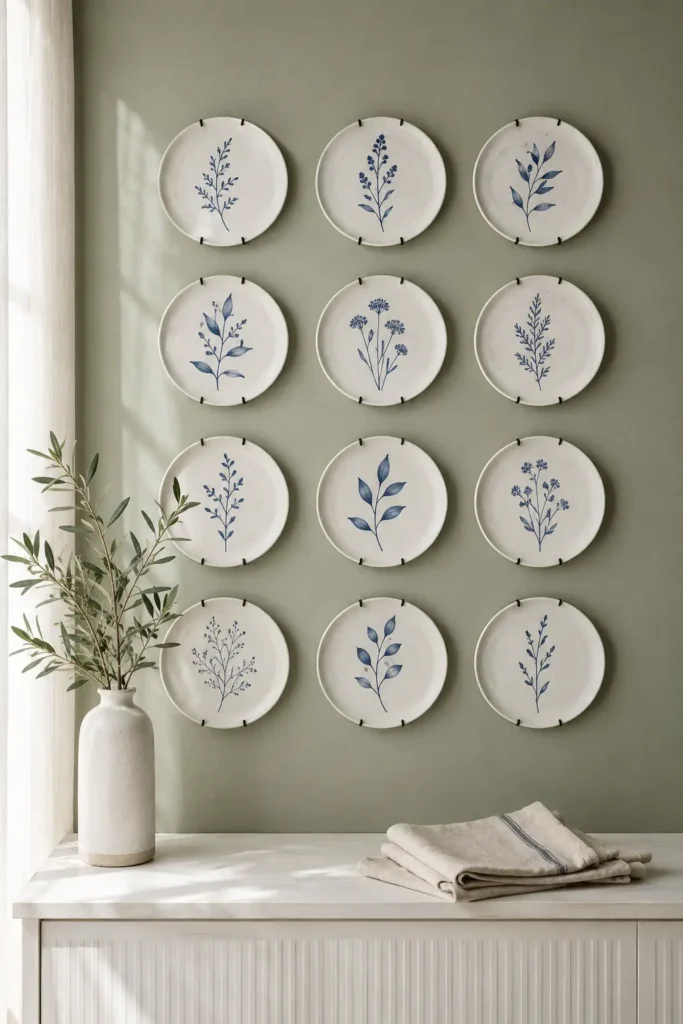
A grid arrangement works because it turns plates into architecture. Equal spacing, matching sizes, clean rows — it reads like an installation rather than a decoration.
- Choose plates with the same diameter but slightly varied patterns or tones — the uniformity of size creates order while the individuality of each plate creates interest
- Space plates 3–4 inches apart for a tight, modern feel; 5–6 inches for something more airy
- Cut cardboard circles the same size as your plates and tape them to the wall with painter’s tape before driving a single nail — this saves hours of frustration
- Use a spirit level on every single row — even a 3mm drift on a grid destroys the visual effect
- Works beautifully above a sideboard or console table with one simple object placed below
Best rooms: Dining rooms, minimal kitchens, hallways
2. 🌀 The Organic Cluster
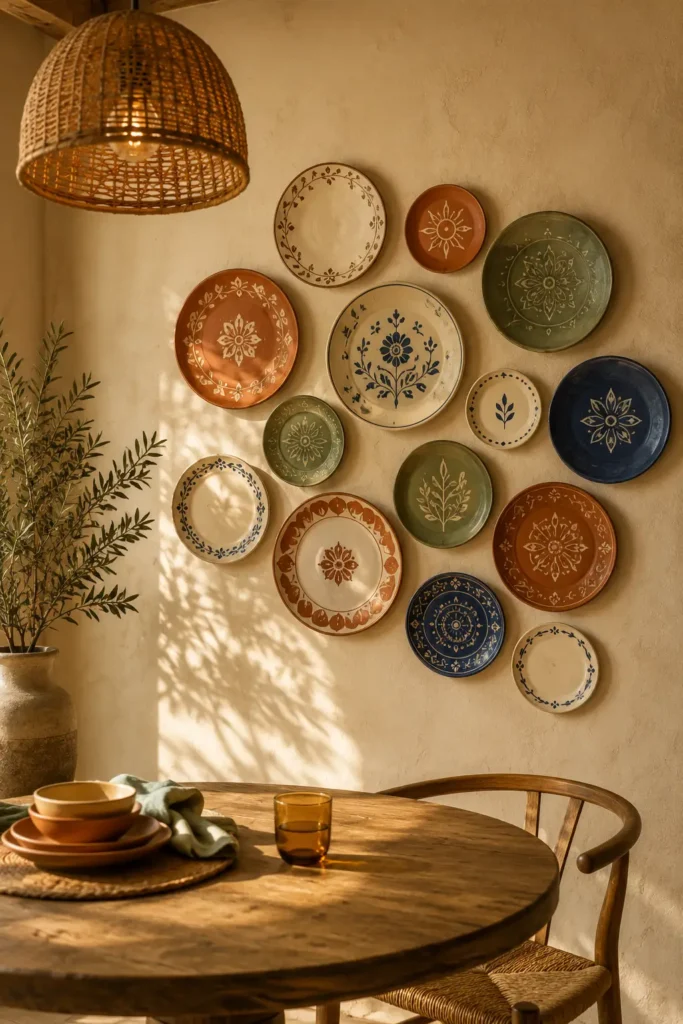
This is the arrangement that looks completely effortless and takes the most planning — because the best organic clusters are designed, not randomly assembled.
- Always lay your plates out on the floor first and trace each one on paper to create a floor template before touching the wall
- Anchor with your largest plate slightly off-center — dead center feels static; off-center feels alive
- Vary spacing deliberately: some plates nearly touching, others with a few inches between them — this variation is what creates the organic quality
- Mix rim depths, plate sizes, and pattern densities within a palette of 3–4 coordinating colors
- Transfer your paper floor template directly to the wall, tape it up, and mark your nail points through the paper.
Best rooms: Boho living rooms, eclectic dining spaces, farmhouse kitchens
3. 🎀 Hanging Plates with Ribbon
Ribbon-hung plates look completely different from hook-hung plates — the ribbon becomes part of the display, adding softness that no metal hardware can replicate.
- Choose ribbon width and material deliberately: velvet reads luxurious, wide grosgrain reads classic, burlap reads rustic
- Thread ribbon through the plate rim, bring both ends up and over a slim nail, and tie a generous bow at the front — the bow is visible and decorative
- Ribbon color can coordinate with the plate — cream ribbon on ivory china — or contrast deliberately, like deep green ribbon against white and gold plates
- Hang multiple ribbon-suspended plates at varied heights, letting ribbons cascade at different lengths for a layered, editorial feel
- Only suitable for lightweight decorative plates — not heavy pottery or stoneware
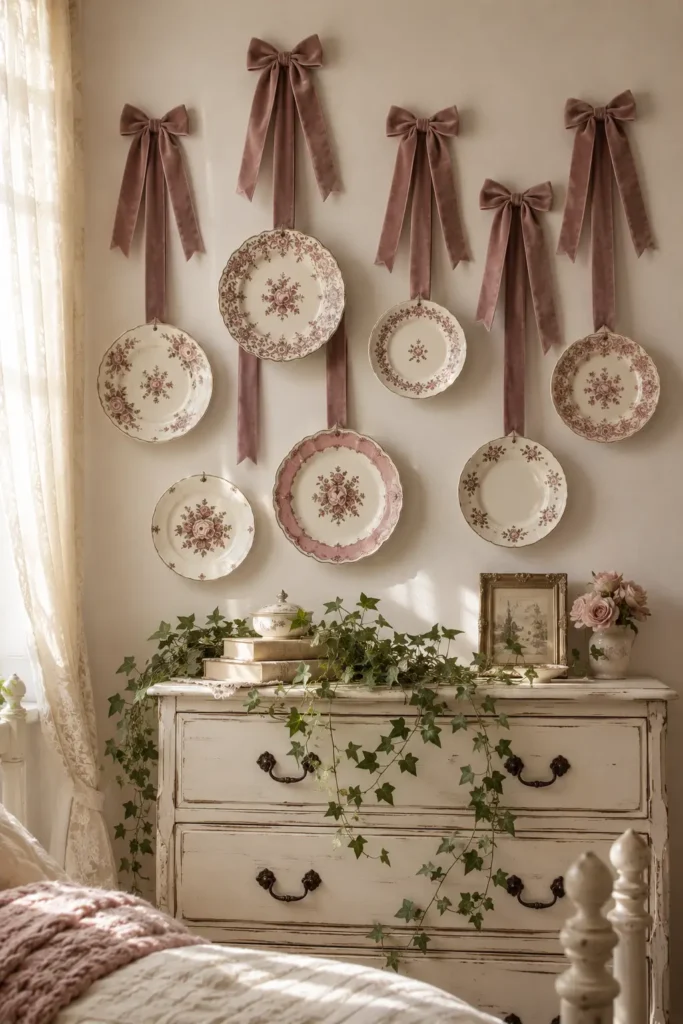
Best rooms: Bedrooms, nurseries, cottage kitchens, romantic dining spaces
4. 🏺 Artisan Pottery Plates
A wall of hand-thrown pottery plates carries a visual energy that manufactured pieces simply don’t have. The organic shapes, uneven glazes, and subtle imperfections are the point — they make the wall feel genuinely alive.
- Let the glaze palette guide the arrangement, not the size or shape — matte sage beside glossy teal beside raw terracotta creates a color conversation that holds the whole display together
- Use spring-style plate hangers that grip the rim from behind invisibly — nothing should distract from the plates themselves
- Embrace the organic shapes: an oval beside a perfectly round one beside a slightly irregular rim tells the story of real human making
- Mix matte and glossy glazes in the same color family for the richest textural depth
- Even three pottery plates grouped together on a small wall section creates a meaningful display
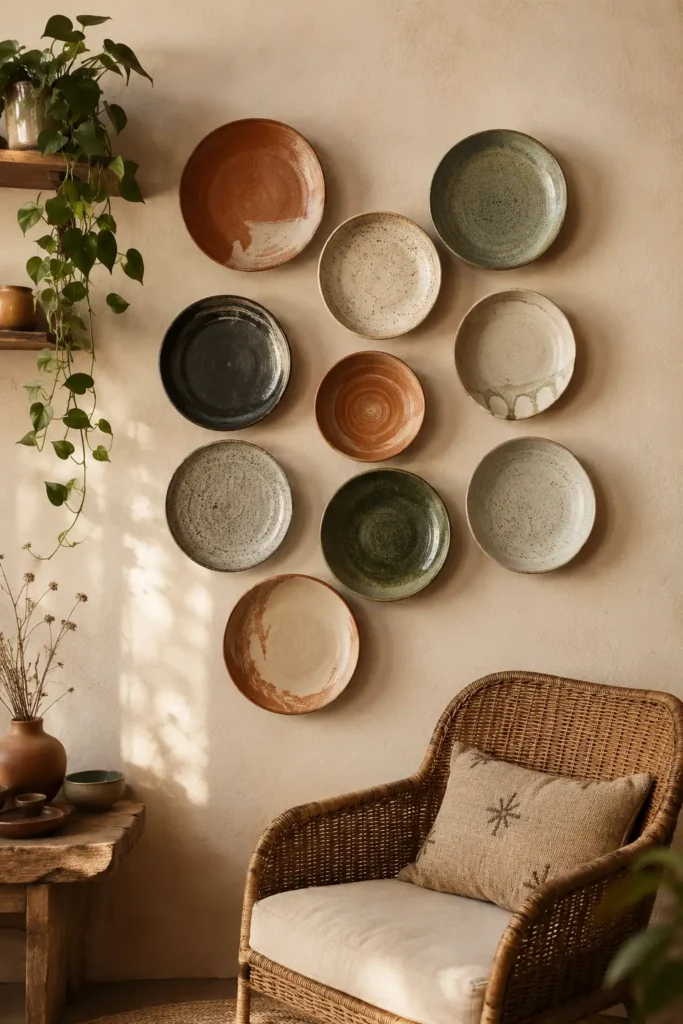
Best rooms: Artist studios, boho living rooms, farmhouse kitchens, eclectic dining rooms
5. 🪞 Ring of Plates Around a Mirror
This turns an ordinary mirror into a room-defining statement — the plates act as a decorative frame that amplifies everything the mirror does.
- Maintain 3–5 inches between the outer edge of the mirror’s frame and the nearest plate rim — too close feels crowded, too far breaks the visual connection
- Use plates that complement the mirror’s style rather than competing with it: ornate gold-framed mirror pairs with plates that carry gold detailing; clean black-rimmed mirror works with bold colored plates
- Hang the mirror first, mark center points at the clock positions (12, 2, 4, 6, 8, 10 o’clock) as your anchor points, then fill between those anchors
- Eight plates in a ring is the most visually balanced number for most mirror sizes
- Works for round, oval, and even rectangular mirrors — just adapt the ring to an oval or rectangle accordingly
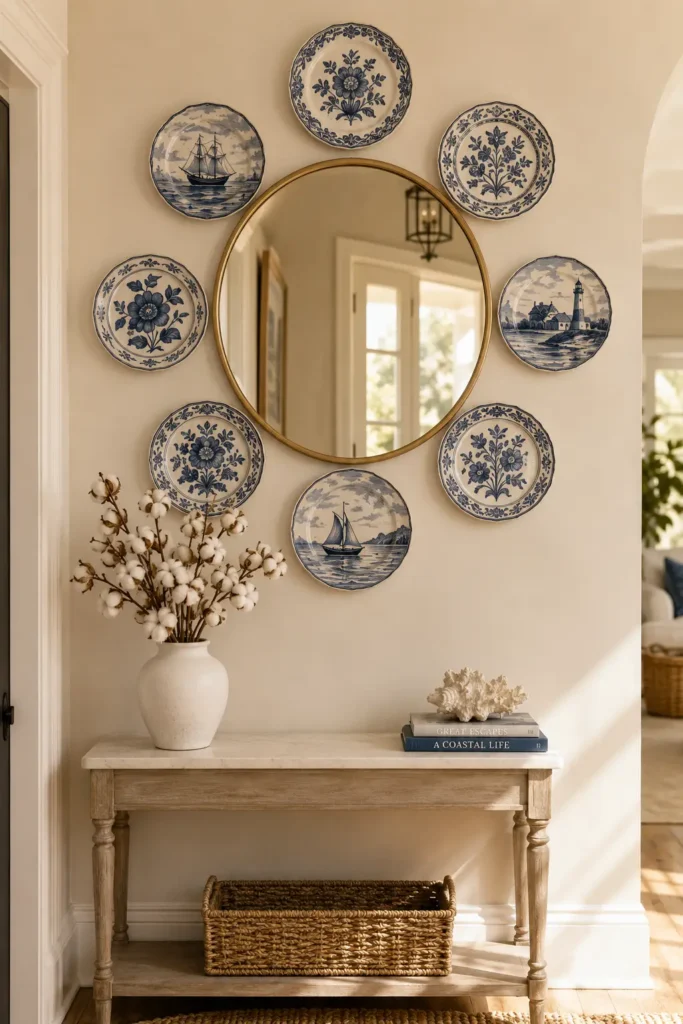
Best rooms: Entryways, above fireplaces, dining room feature walls
6. 🍳 Kitchen Plate Wall
Plates in a kitchen feel completely natural — and the most successful kitchen plate walls blur the line between practical and decorative in a way that feels genuinely lived-in.
- Use the vertical space above open shelving, or the gap between cabinets and windows — work with the kitchen’s architecture rather than around it
- Choose a palette rooted in the kitchen’s existing tones: cream cabinets pair with sage, terracotta, or dusty blue plates; white kitchens can handle bolder cobalt or forest green
- A staggered row of 5–7 graduating plate sizes works in most kitchen wall sections
- For above-cabinet displays where spring hangers are impractical, use adhesive disc hangers or small plate stands
- Echo the plate palette in a small herb pot or ceramic canister on the counter below to tie the display into the room
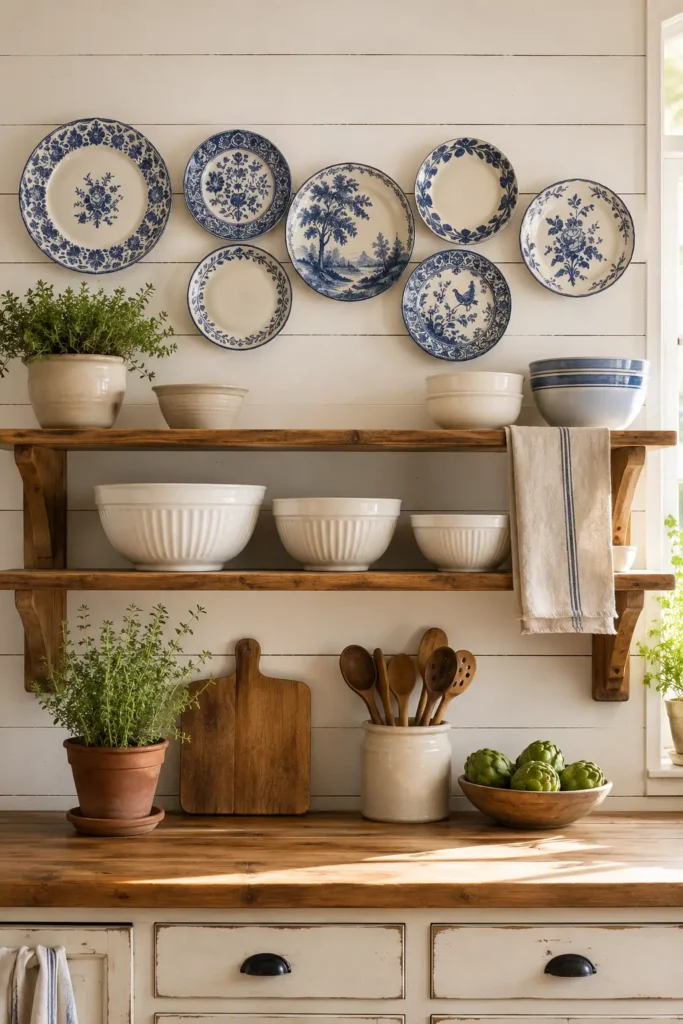
Best rooms: Open-plan kitchens, farmhouse kitchens, kitchen-dining areas
7. 🛏️ Plates as a Headboard Alternative
Plates arranged in an arc above a bed create a soft, rounded silhouette that works in genuine harmony with the horizontal lines of pillows and bedding — and for rooms without a traditional headboard, this is often a more striking solution.
- Map the arc using a piece of string pinned at the center point above the bed’s center — this becomes your planning compass
- Use 7–11 plates: smaller plates at each end curving up to the largest plate at the highest arc point
- Choose soft tones that echo your bedding colors — dusty pink for linen bedding, sage for botanical rooms, muted blue for a coastal sleep space
- Safety is non-negotiable: use proper spring hangers anchored into wall studs for any plates hung above a sleeping area
- Check the weight rating of your hangers against the actual weight of each plate before installing
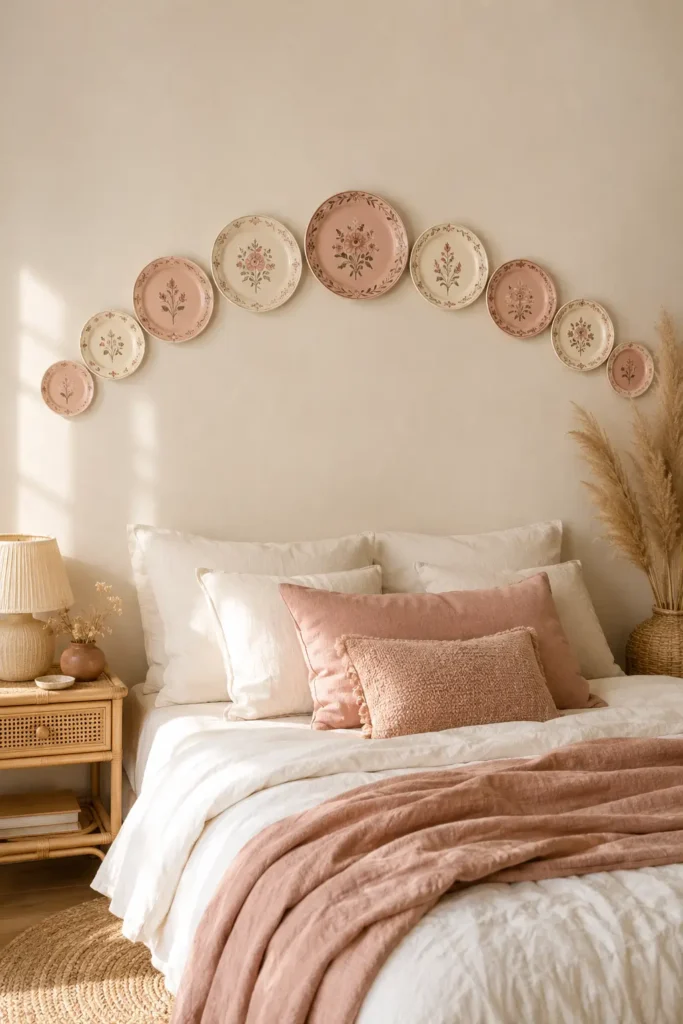
Best rooms: Bedrooms without headboards, guest rooms, romantic master suites
8. 📏 Vertical Column for Narrow Walls
The strips of wall that defeat most decorating — the sliver beside a doorframe, the narrow gap between windows, the tall corridor column — work beautifully with a vertical plate column.
- Choose 3–5 plates and space them 4–5 inches apart in a true vertical line
- For a uniform column, use identical plates — the repetition reads as architectural and deliberate
- For a more dynamic look, graduate sizes: largest at the center of the column, smaller plates above and below, forming a subtle diamond within the vertical line
- This makes low ceilings feel taller and elongated spaces feel more intentional
- Works especially well in powder rooms, beside fireplaces, and in stairwell alcoves
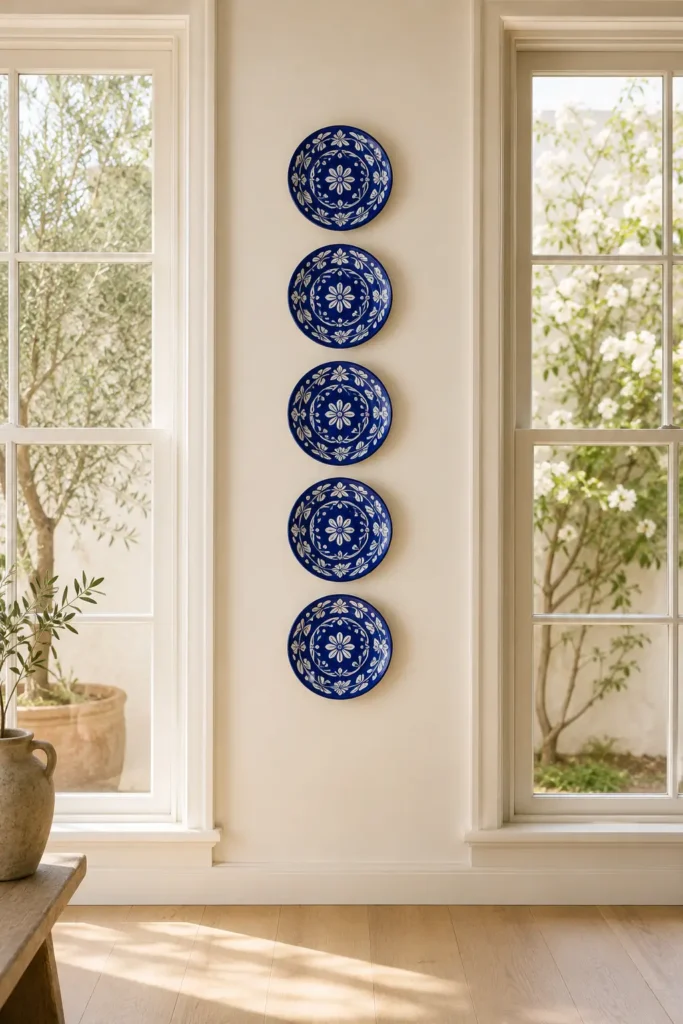
Best rooms: Narrow entryways, hallways, powder rooms, beside doorframes
9. 🎨 Single Statement Ceramic
Sometimes one extraordinary plate, given enough space, does more than twenty plates crowded together. The most confident plate display in any room might be the simplest one.
- Choose a plate between 14–24 inches in diameter for genuine visual presence
- Hang it centered on the wall at eye level with at least 18 inches of clear space on all sides
- Wall color matters enormously: deep charcoal or forest green elevates a white ceramic into something museum-worthy; warm neutral walls let a colorful piece be the sole focus
- Add a single small floating shelf directly below the plate and place one complementary object — a bud vase, a small stone — to ground the piece in the space
- The shelf creates a visual base that completes the vignette without competing with the plate
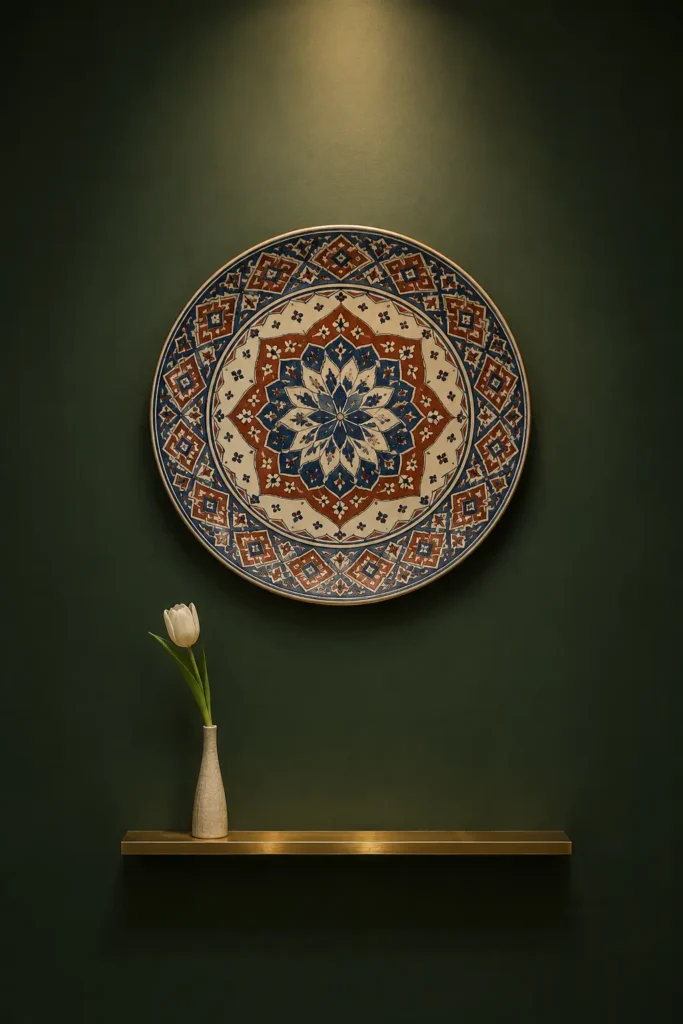
Best rooms: Dining room feature walls, living room art moments, home entrances
10. 🕐 The Clock Circle
Twelve plates arranged at clock positions create a display that’s perfectly balanced and visually complete — the eye traces the full ring and returns satisfied.
- Pin a string to the wall at your chosen center point and sweep it like a compass to mark each plate’s center position
- For 12 plates, space at every 30 degrees; for 8 plates, every 45 degrees
- Use same-size plates for clean geometry, or alternate two sizes — larger and smaller — for a sun-burst effect
- Place a single accent plate in a different color at the 12 o’clock position to introduce a subtle focal point within the balanced arrangement
- Hang the center reference object (mirror or artwork) first, then build the ring outward from there
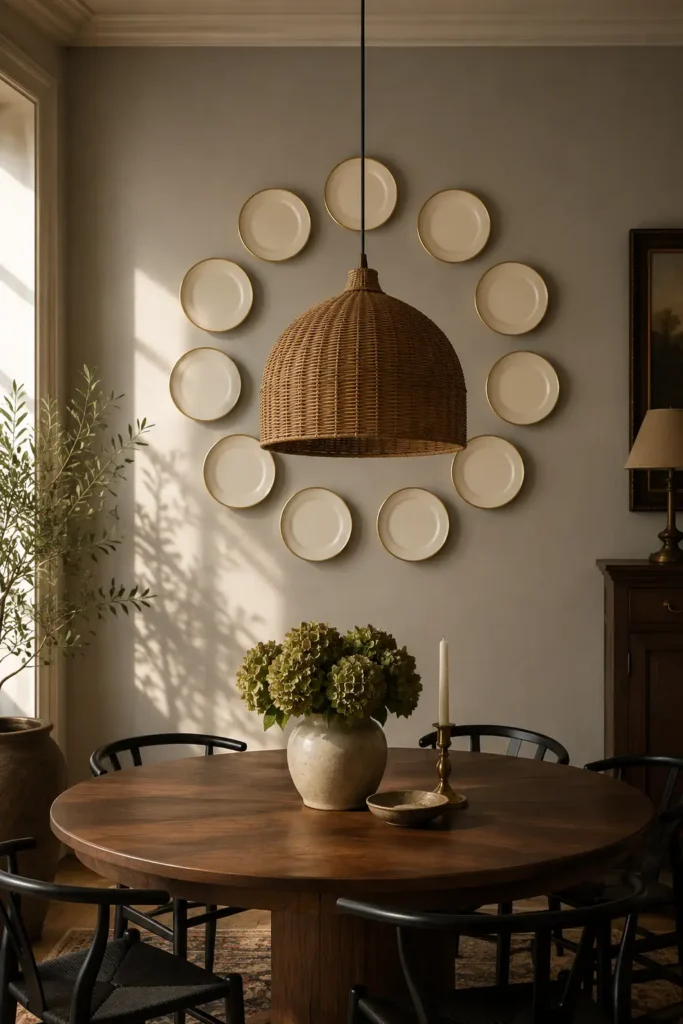
Best rooms: Above round dining tables, foyer walls, formal living rooms
11. 🪵 Plates on Painted Wooden Panels
Mounting plates onto painted panels before hanging them adds a layer of depth and visual importance that single-surface hanging cannot achieve — the panel acts like a mat in traditional picture framing.
- Cut wooden boards proportional to your plate: a 10-inch plate pairs well with a 14×14-inch panel, giving a 2-inch border all around
- Paint each panel in a color chosen for its plate: sage behind cream ceramic, matte black behind white and gold, warm terracotta behind neutral pottery
- Mount the plate on the panel using a spring hanger secured into the panel wood, then hang the entire assembly
- Linen-covered panels behind pottery plates add a layered, deeply tactile quality
- Arrange 3–5 panel-plate combinations in a grid or loose cluster for maximum impact
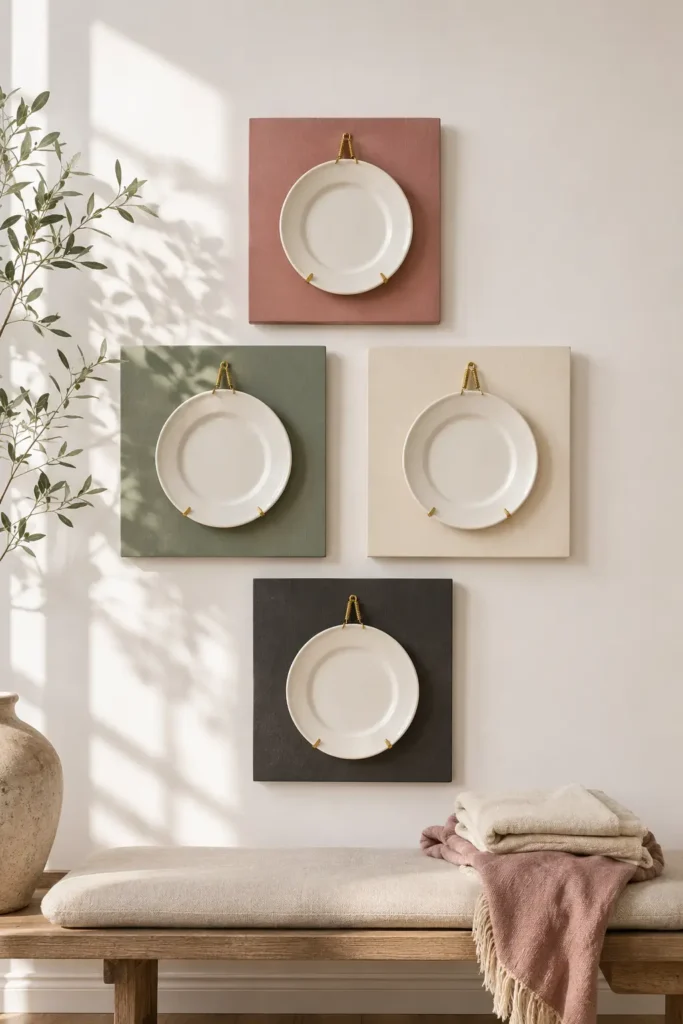
Best rooms: Dining rooms, living room feature walls, home offices, boutique-style bedrooms
12. 🌸 Outline a Window or Doorframe
Using plates to frame an architectural element — a doorway, a window, an arch — reinforces lines that already exist in the room and makes those features feel significantly more important.
- Use small to medium plates (6–10 inches) so the plates frame without overwhelming the architecture
- Maintain 3–4 inches from the frame edge and 4–5 inches between each plate, consistent all the way around
- For an arched doorway, trace the curve onto paper first and use it to mark plate positions before committing
- Alternate two complementary plate designs around a window for gentle visual rhythm
- This works especially well in homes with architectural character — Mediterranean, cottage, or farmhouse styles
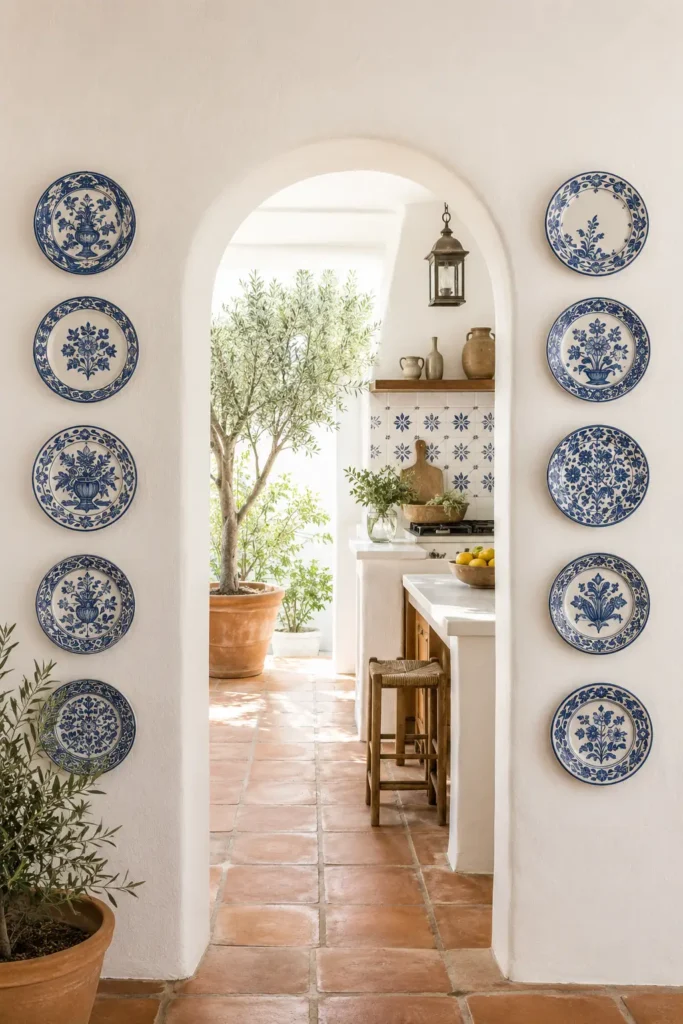
Best rooms: Arched doorways, kitchen windows, entryway door frames
13. 🏡 Staircase Diagonal Display
Staircase walls have a natural diagonal movement that most art arrangements fight against. A plate wall arranged to follow that diagonal works with the architecture and creates a display that feels completely at home in the space.
- Follow the diagonal of the staircase’s banister line — maintain spacing that’s consistent diagonally, not horizontally or vertically
- Use larger plates near the base of the staircase where the wall is tallest, transitioning to smaller plates as the wall narrows above
- Limit to 2–3 coordinating colors so the diagonal movement doesn’t fragment the visual story
- Start planning from the visual midpoint of the staircase wall and build outward in both directions
- Stand at the bottom and top of the staircase when reviewing your paper template — it looks different from each vantage point
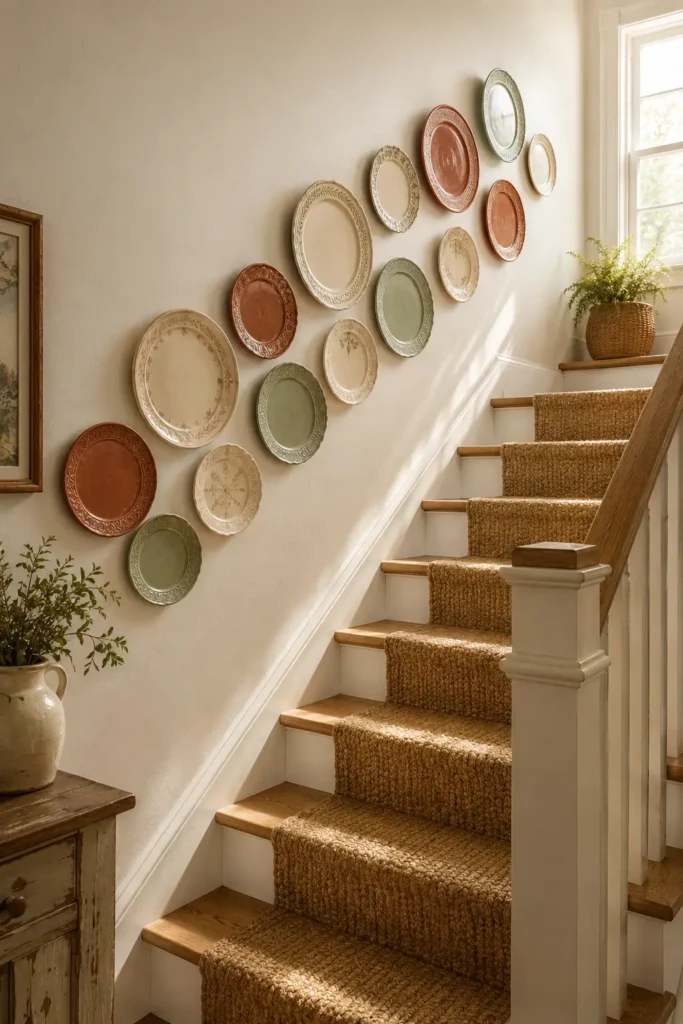
Best rooms: Any staircase wall, regardless of home style
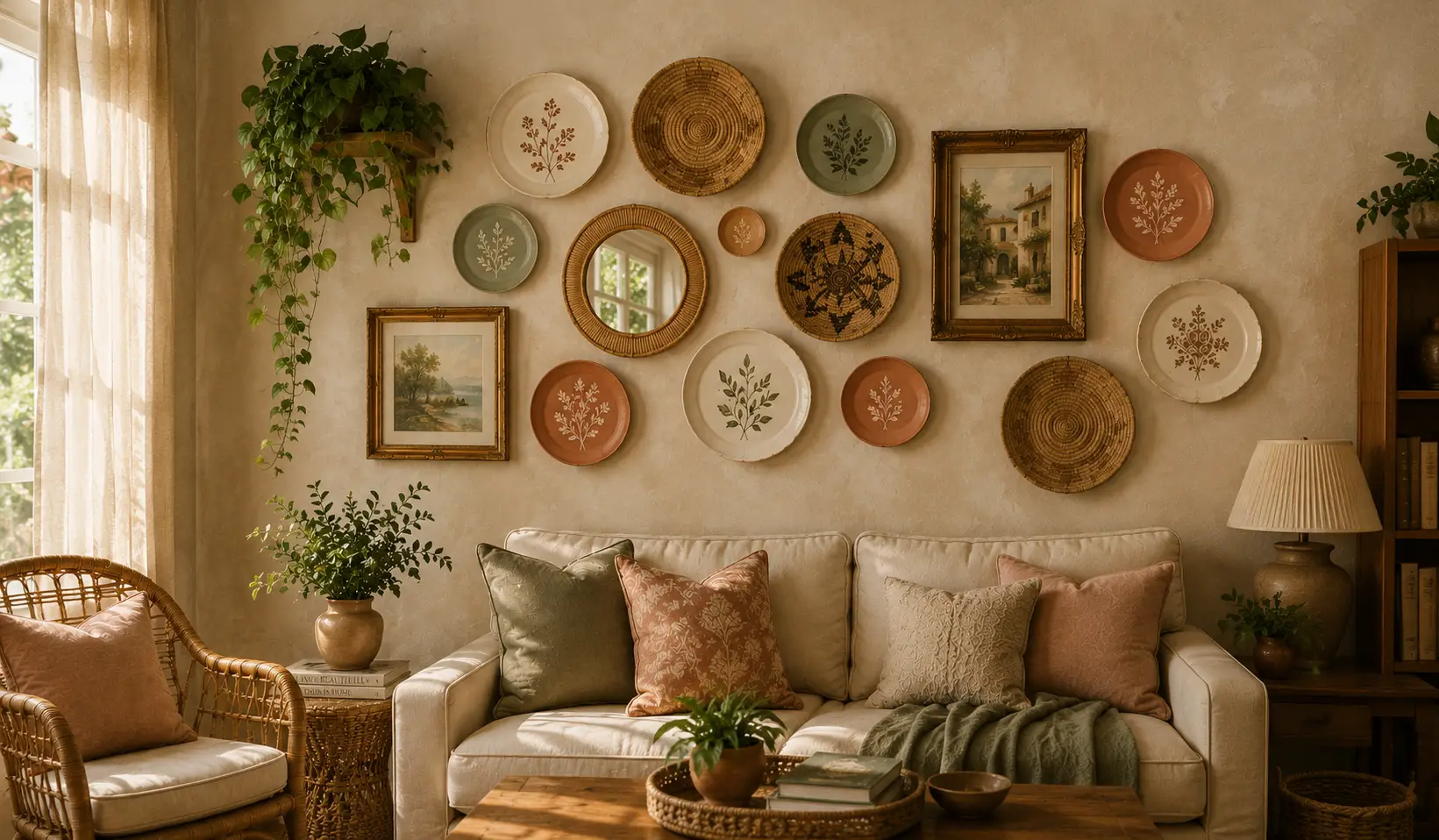
14. 🌿 Mixed Media — Plates with Baskets and Greenery
Plates don’t have to stand alone. Mixing them with woven wall baskets, framed botanical prints, and trailing plants creates a layered display with a richness that single-medium walls simply cannot achieve.
- Think of plates as the main anchors and everything else as a supporting cast — distribute supporting elements throughout the plate arrangement rather than grouping them separately
- Woven baskets in coordinating tones add natural texture; small framed watercolors introduce a graphic element; trailing plants add living, breathing softness
- Keep a consistent color palette across all elements — earthy terracotta, sage, cream, and natural fiber tones hold mixed-media arrangements together beautifully
- Space baskets and prints between plates, not beside them — the interweaving creates unity
- This approach hides the planning completely — the result looks completely organic
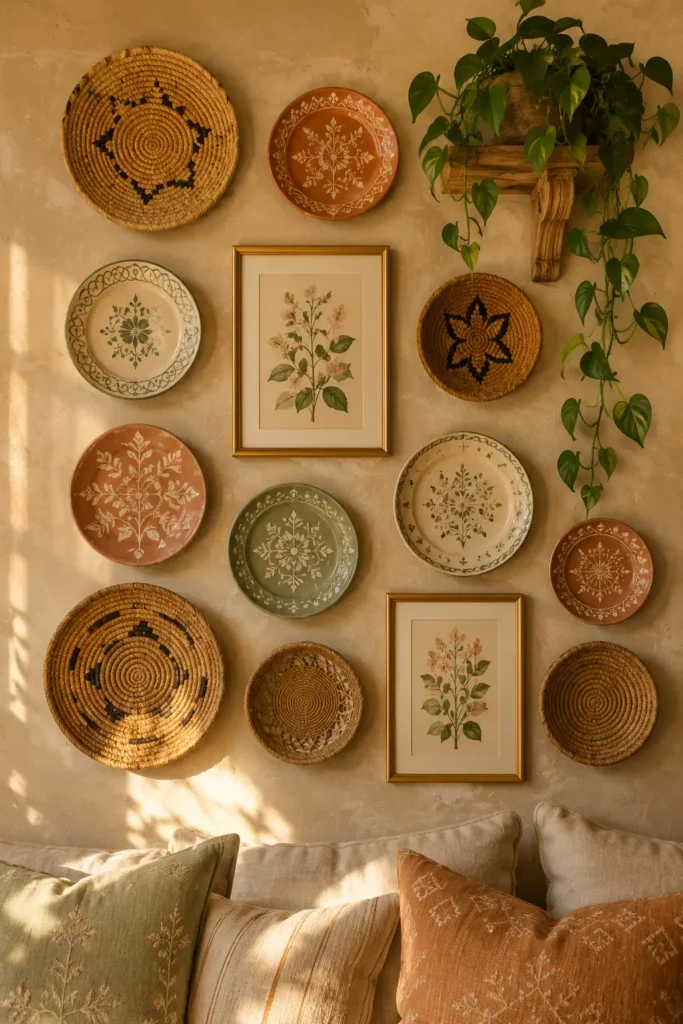
Best rooms: Boho living rooms, eclectic dining spaces, bedroom accent walls
15. 🔵 Monochrome Display with One Accent
All the plates in one color family except one — that single contrasting plate becomes the most important element in the room.
- Source plates in at least 4 distinct tones of your chosen color: pale, clear mid-range, deep saturated, and grey-shifted muted
- Arrange them in a cluster, distributing the tones so no corner feels too dark or too light
- Place the accent plate slightly off-center — never dead center — for the most sophisticated, modern feel
- For a blue display, a single terracotta accent creates warm unexpected contrast; for green, a deep burgundy accent creates jewel-like richness
- Pull the dominant color from something already in the room — a rug, a cushion, a tile — so the display integrates rather than competes
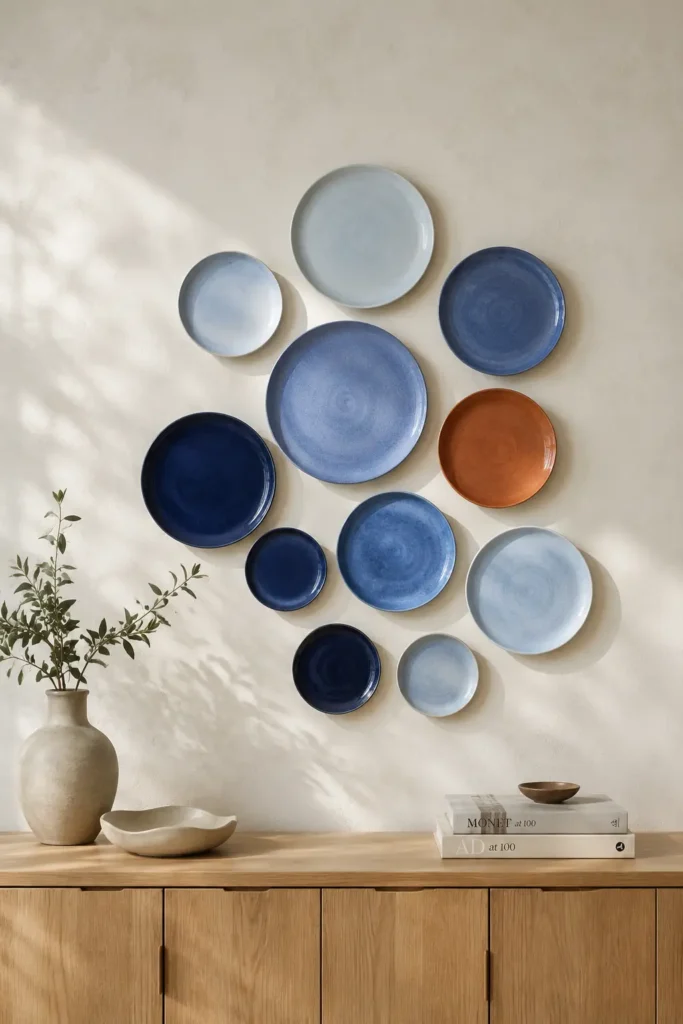
Best rooms: Living rooms, dining rooms, any space needing a cohesive color statement
16. 🌍 Plates Grouped by Cultural Origin
Grouping plates from specific countries or traditions creates a wall that functions as genuine narrative — especially when the pieces connect to personal travel history or family heritage.
- Group plates from the same region in loose clusters within the larger arrangement, then let those regional clusters converse across the wall
- Add small hand-written origin labels on kraft card suspended from twine beside each cluster — it transforms the display from decorative to genuinely fascinating
- Seek authentic handmade works rather than reproduction pieces — the authenticity shows in the ceramic itself
- Research the tradition behind each piece before displaying — understanding what you’re showing adds depth to how you arrange it
- Include only pieces you genuinely connect with; a culturally themed wall built entirely from estate sales or personal travels feels fundamentally different from one assembled from online shopping
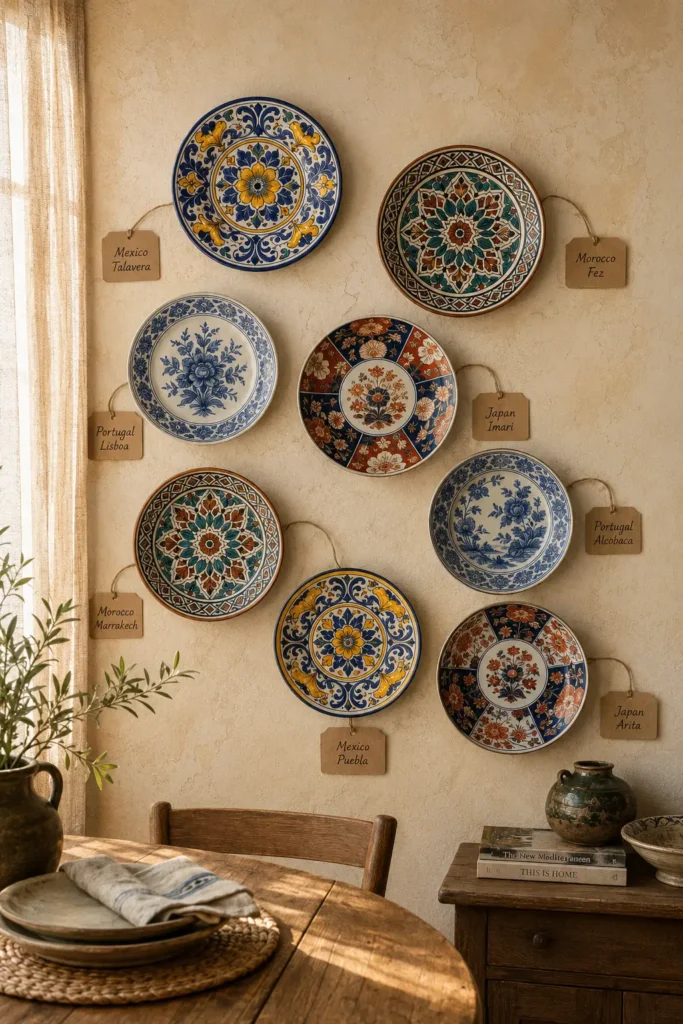
Best rooms: Dining rooms, living rooms, home libraries, study spaces
17. ✍️ Text and Monogram Plates
Plates bearing words, initials, or meaningful quotes introduce a personal dimension into a decorative display — they make the wall feel specifically yours.
- Limit to 1–2 text plates per display cluster — beyond that, the graphic elements overwhelm the visual pieces
- Match the lettering style to your interior: clean serif initial for traditional homes, hand-lettered script for relaxed or rustic spaces, simple lowercase for modern rooms
- Position text plates where the eye naturally rests — slightly off-center in the arrangement, or at the visual anchor point
- Balance text plates with plain or subtly patterned plates on either side so the words have breathing room
- A family initial plate centered in a gallery cluster adds immediate personal meaning without requiring any explanation
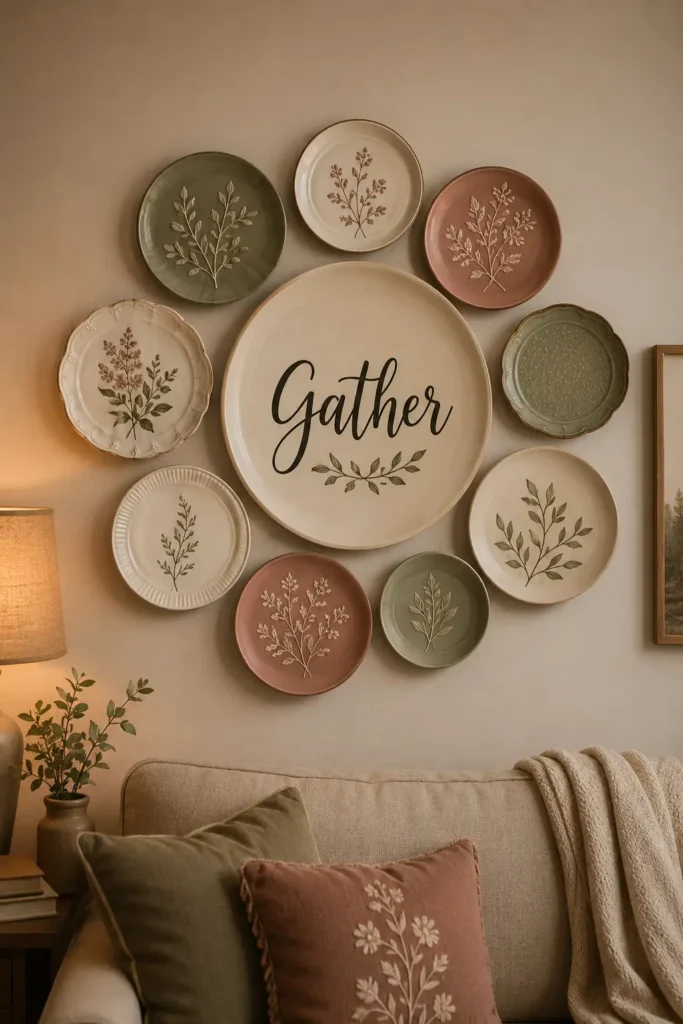
Best rooms: Living rooms, dining rooms, entryways, family spaces
18. 📚 Picture Ledge Display — No Permanent Holes
For renters, or anyone who wants complete flexibility without wall damage, picture ledges make plate display entirely commitment-free.
- Install a single slim ledge for a casual single-row display, or stack 2–3 ledges at different heights for a layered, dynamic arrangement
- Lean plates of varying sizes against the wall: taller pieces toward the back, smaller ones in front, for depth within a shallow ledge space
- Paint the ledge to match the wall and it nearly disappears — all you see are the plates
- Tuck small framed prints, a miniature vase, or a folded linen between plates for a naturally styled look
- The entire display can be changed in minutes — no tools, no wall repairs, no commitment
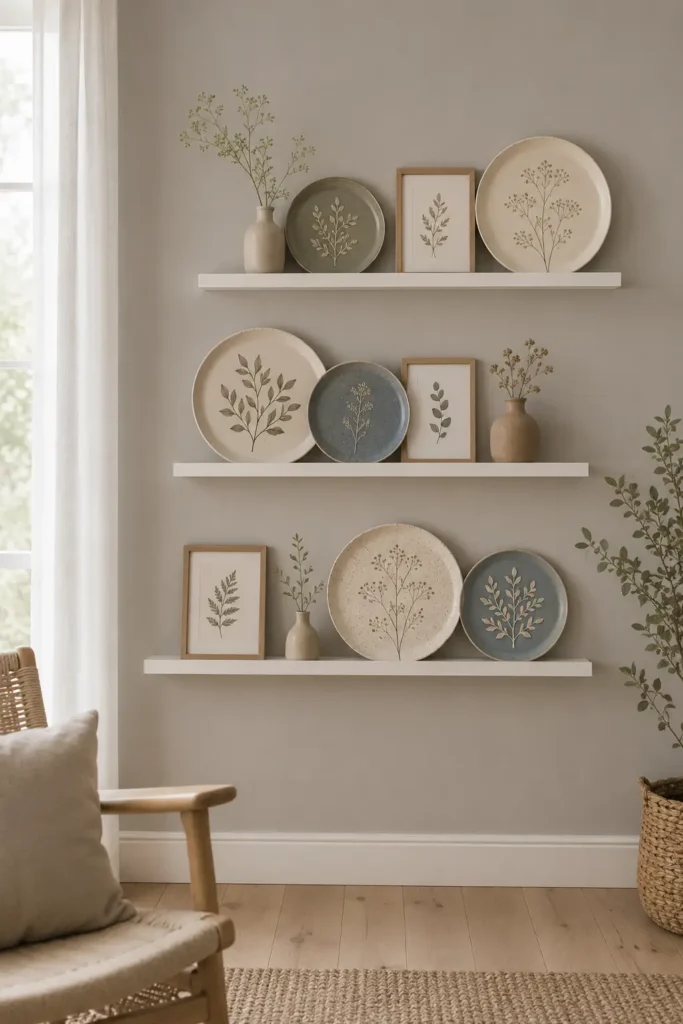
Best rooms: Rental apartments, rooms where seasonal changes matter, anywhere flexibility is a priority
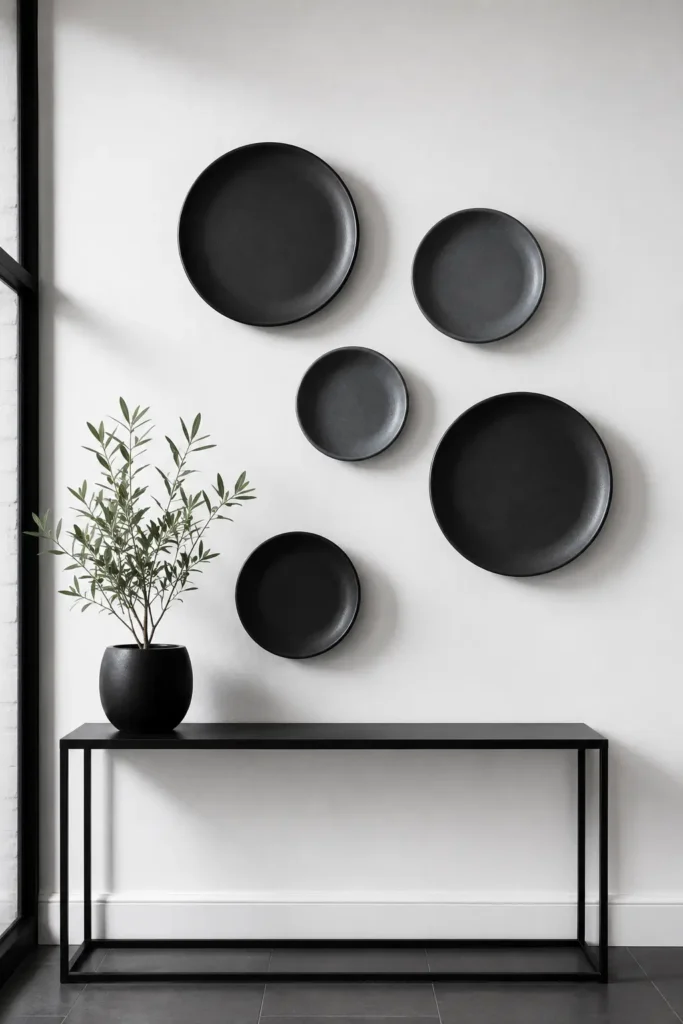
19. 🌟 Modern Plate Wall — Bold, Minimal, Graphic
Modern plate displays use fewer plates with more space between them — letting negative space do as much visual work as the plates themselves.
- Choose plates with bold graphic qualities: pure matte black circles, stark white with a single geometric line, deep cobalt discs with no decoration
- Leave 6–10 inches between plates rather than the 3–4 inches of traditional arrangements — the space between is actively part of the design
- Choose a wall color that provides strong contrast: deep charcoal behind white plates, warm white behind colored ceramics
- An asymmetric cluster of five carefully chosen plates with generous spacing carries more visual confidence than twenty crowded ones
- Resist the urge to fill gaps — the restraint is the entire point
Best rooms: Modern apartments, minimalist living rooms, design-forward dining spaces
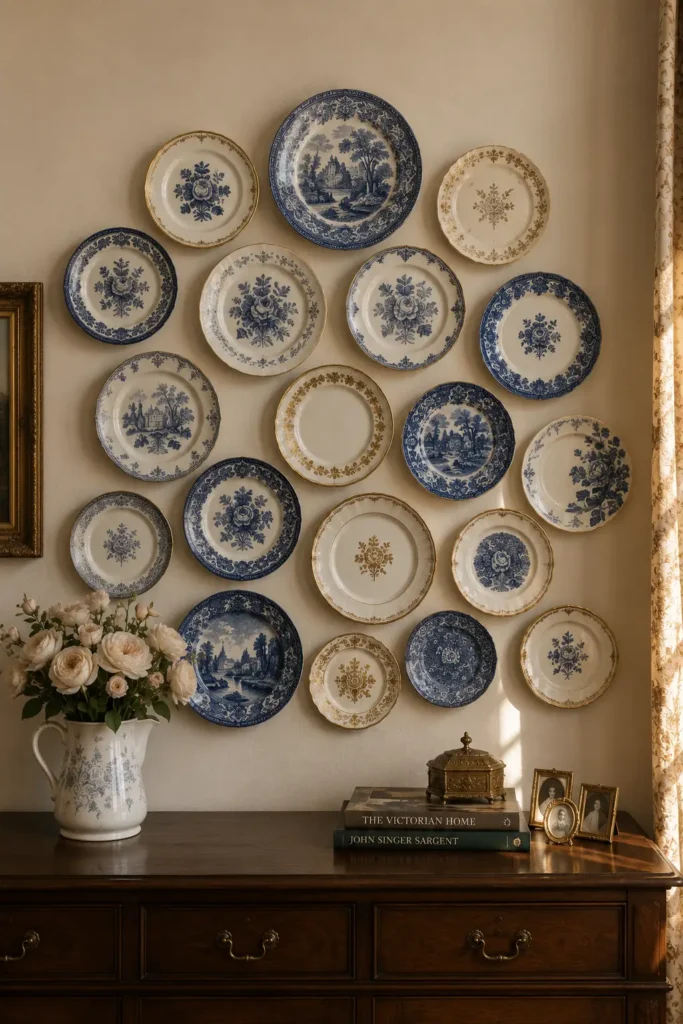
20. 🌸 Vintage Plate Wall
A wall of genuine vintage plates is a visual archive — pieces that survived decades because they were too beautiful to discard. That survival history alone makes them extraordinary to look at.
- Apply a strict shared palette — cobalt blue, warm white, and soft gold, for example — and edit your collection ruthlessly to include only pieces that carry those colors, regardless of era or style
- Within that palette, embrace variety: mixing plates from different decades and manufacturing traditions is exactly what creates the richness
- Arrange in a loose organic cluster with consistent 3–4 inch spacing
- Hang slightly higher than you think is right — vintage displays benefit from the extra breathing room above eye level
- Include one plate with a small chip or crack — the imperfection adds authenticity and charm to the story
Best rooms: Cottage dining rooms, traditional living spaces, romantic bedrooms, farmhouse kitchens
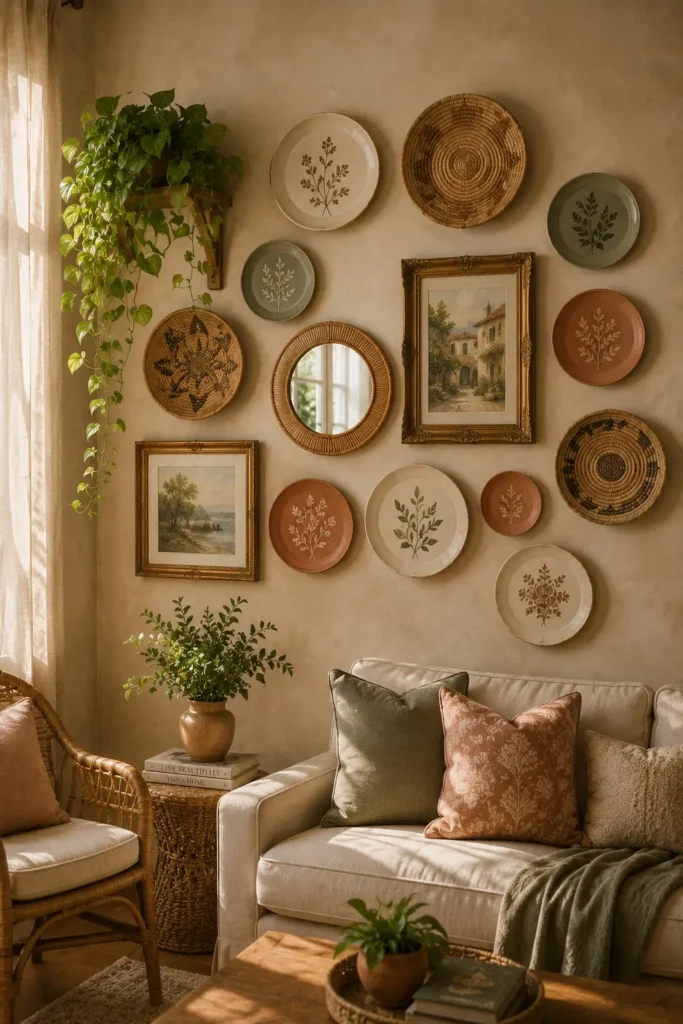
21. ✨ The Full Eclectic Gallery Wall
Plates living alongside framed art, woven baskets, macramé, ceramic sculptures, and mirrors — this is the most personal and most ambitious plate display, and when done with genuine intention, it becomes the defining feature of the room.
- Define your unifying logic before acquiring anything: a shared color palette (3–4 defined hues), a shared material (clay, natural fiber, aged wood), or a shared era (vintage, handmade)
- Within that logic, build boldly — mix oversized with tiny, refined with raw, graphic with organic
- Distribute plates throughout the arrangement as visual anchors — their reflective ceramic surfaces and strong circular shapes hold the composition together
- Map the entire arrangement on paper or on the floor before touching the wall, adjusting by eye until the overall weight feels balanced
- Once you commit, commit fully — the display only works when it’s genuinely complete
Best rooms: Living rooms, dining rooms, creative studios, any space where maximalist warmth is welcome
🛠️ Quick Practical Guide Before You Start
Choosing hangers:
- Spring-style plate hangers grip the rim from behind — largely invisible at normal viewing distance, best for heavier plates
- Adhesive disc hangers bond to the back of the plate with no visible hardware — best for antique or decorative pieces
- Ribbon hanging works only for lightweight decorative plates
Planning your layout:
- Cut paper circles the same size as each plate, tape to the wall with painter’s tape, adjust freely, then mark nail points through the paper before removing — this step alone prevents most mistakes
- Use a spirit level for any grid or structured arrangement
Spacing that works:
- 3 inches — intimate and lush, suits organic and boho clusters
- 4–5 inches — versatile, works for most styles and rooms
- 6–10 inches — airy and architectural, best for modern minimal displays
Weight and safety:
- Plates over 12 inches — always anchor into a wall stud or use rated drywall anchors
- Above-bed installations — use a stud finder and check hanger weight ratings before planning
- Start with five plates before committing to a large arrangement — you can always add more
Plates are one of the most flexible, personal, and genuinely beautiful things you can put on a wall. Start with three pieces you already love, lay them on the floor, and see what they look like together. The rest follows naturally from there. 🍽️✨